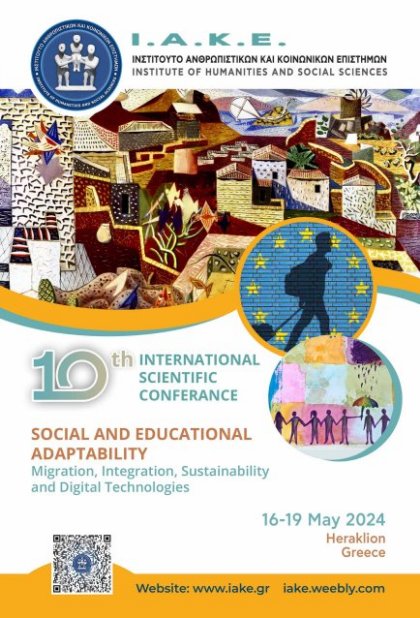
The Institute of Humanities and Social Sciences, after the successful holding of nine National/International Scientific Conferences, is pleased to announce to its members, associates and friends, the scientific and educational community and any interested party, that it is planning the organisation of the 10th International Scientific Conference, with a central theme:
PROBLEM OF THE CENTRAL ISSUE
As every year, the Conference is designed with a view to embracing a broad and cohesive family of concerns that revolve around the crucial relationships between education and multiple contemporary concerns. We are at a crucial crossroads at which the relationships of social, economic and political systems are reshaping and reshaping ways to address global challenges. Updated challenges include managing the increase in migration flows, reducing inequalities through integration, the need to redirect towards sustainable development and exploiting the evolution of digital technologies. This Conference offers a structured, scientific framework for discussing, exchanging views and developing solutions that will contribute to the promotion of social and educational adaptability at these crucial crossroads.
The movement of populations is a phenomenon which has occurred since antiquity and will continue to accompany developments in the history of human social organisation. The causes, dimensions and forms of the phenomenon vary according to geoeconomics, geopolitical and general spatial-temporal parameters. The economic situation, the social culture, the geographical and geopolitical position of a country are key factors on which the likelihood of dealing with strong migratory flows depends, while it has been assumed that the choice of a migration destination can be analyzed in relation to “push-pull factors”. “Push factors” lead people to leave their countries and seek a better fortune elsewhere, while “attractive” factors refer to the reasons why people seek asylum in certain countries rather than in others.
Integration, integration and assimilation are three fundamentals but also quite different concepts. They refer to distinct approaches to dealing with the migration phenomenon and refer to three different but partly related prisms. Although some insist on confusing them, integration and assimilation are different approaches. In any case, if inclusion remains the main objective, ways can be shaped and valued in different ways. Thus, for example, social inclusion through education, e-learning and access to employment is a major issue for the integration of migrants into a modern society. Whether this is also an assimilation into a culture is a distinct chapter addressing a number of serious issues, including the notion of respect for the diversity of young members of society.
At the same time, in today’s era, the values of holistic sustainability are more necessary than ever, as we face complex challenges such as climate change, depletion of natural resources and increasing global population pressure. Education plays a key role in promoting sustainability by informing, sensitizing and inspiring people to develop sustainable behaviors and implement practices that respect the environment and preserve nature for future generations. In addition, education teaches the importance of cooperation and dialogue at the global level, promoting the development of international policies and practices that enhance sustainability around the world. Thus, linking sustainability with education paves the way for a sustainable future, where the values of nurturing the environment and maintaining balances in nature remain alive and enhanced.
Linking migration, integration and sustainability to digital technologies represents a complex challenge in the modern world. Rapid developments in the digital sector create new opportunities, but at the same time, in case of non-holistic access, they may reinforce inequalities. The use of digital educational tools paves the way for improving educational access for migrants, allowing them to learn the language, cultural elements and skills needed to integrate into the new society. At the same time, digital platforms can encourage intercultural exchange, facilitating understanding of differences and building bridges of understanding between different cultures. In addition, the proper use of digital technologies in education can promote sustainability by educating young generations to use technologies in a skillful way and to develop critical thinking about the challenges of the digital world.
Success in addressing these challenges depends on society’s ability to adapt and address these changes in an efficient and sustainable manner. This conference highlights the importance of social and educational adaptability at these crucial crossroads, offering a platform for discussing, exchanging opinions and developing solutions that will guide us towards a sustainable and prosperous future. The Conference addresses scientists of all views and approaches and wishes to be a meeting point and exchange of views on this major issue at a particularly critical moment for its development.
The main purpose of the 10th IAKE Conference is the critical investigation and development of scientific dialogue on these issues.
Starting from the central theme, the Conference focuses its interest on the following thematic areas, without excluding those others arising from its more general title:
The following can be presented at the conference:
The above include scientific announcements, research, studies, good practices, teaching scenarios, presentations of educational software and materials, etc., related to the central theme and thematic areas of the Conference. The Court’s minutes publish the full texts of all the papers approved by the judges, regardless of the form of their presentation. Detailed instructions on the structure and format of the recommendations and announcements will be posted on the websites of IAKE.
In addition, the proceedings of the Court include:
IMPORTANT DATES AND INFORMATION
Start submission of abstracts: 27 November 2023
End of submission of abstracts: 22 January 2024
Information on acceptance of abstracts and participation: until 19 February 2024
End of submission for the Conference: 18 March 2024
Conduct of the Conference: 16-19 May 2024
Those who wish to participate in the Conference as rapporteurs – with a recommendation or an posted announcement or workshop – should send an abstract of your work through the special form on the website: http://www.iake.gr or https://iake.weebly.com/, where the required instructions are available. The text of the summary must be up to 300 words and must be accompanied by the details of the authors, as well as the type of work and the thematic axis to which it belongs.
Each paper may be submitted from one to four rapporteurs. Each rapporteur may participate with a maximum of two tasks, in his capacity as first, second, third or fourth rapporteur.
Acceptance or not of the summary will be announced by 19 February 2024.
The rapporteurs will pay the due amount of participation after the approval of their summary, on the dates announced in a subsequent announcement.
I.A.K.E. will award the best scientific work, per thematic axis of the Conference, in the following categories:
A. Better scientific work
B. Better teaching proposal
In order to support young researchers and scientists, the most evaluated work will be awarded, as a subsidiary, to be submitted by: a) undergraduate students, b) postgraduate students, c) young scientists presenting for the first time a scientific paper.
The results of the Competition will be extracted by the Scientific Committee on the basis of the general results of the anonymous judgement of the final works. The assessment of the final texts follows the assessment of the summaries. The full texts of the work are assessed on the basis of their qualitative characteristics in the following criteria: a) originality, b) methodology, c) structure, d) content, e) documentation.
Only the works submitted by 18 March 2024 will participate in the award.
The award of praise and distinctions will take place at the closing ceremony of the Congress. Instructions for the preparation of the complete texts of the final works can be found on our webpages: https://www.iake.gr/ and https://iake.weebly.com/.
PARALLEL EVENTS
In the framework of the Conference, a series of parallel activities and events are planned, aiming at the acquaintance, entertainment and interaction of the delegates and their escorts.